
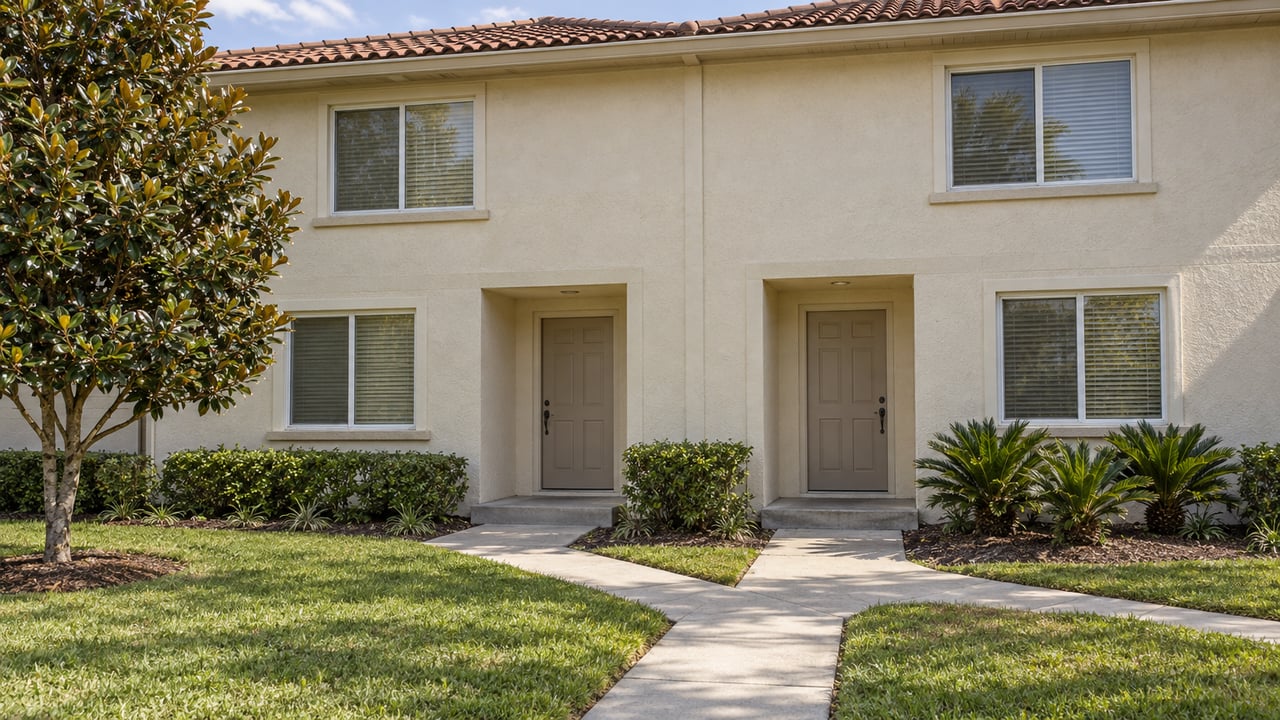
"All Rentals are limited to 120 days or less. Owner occupancy can not exceed 25%." That rule sits on the homeowners association page for Terra Verde Resort in Kissimmee. The next sentence asks anyone planning to buy there as a primary residence to contact the resort's general manager before writing an offer.
That one paragraph tells you how much of Kissimmee's condo and townhome market works. The paint, the kitchen and the list price matter. Before any of them come into play, though, the community's own documents have already decided which buyers can close, and how. Right now that is showing up in how long attached homes take to sell.
Same County, Opposite Directions
Osceola Realtors' county report for August 2026 shows single-family homes and condos/townhouses moving in different directions compared with August 2025.
- Single-family homes, August 2026: median time to contract fell to 46 days from 52. Months of supply slipped to 5.9 from 6.1.
- Condos/townhouses, August 2026: median time to contract rose to 59 days from 44, a 34.1% jump. Months of supply rose to 8.8 from 8.4.
- Condo/townhouse pricing, August 2026: the median sale price was $312,995, down just 1.3%. The median sale came in at 95.2% of original list price, compared with 95.5% a year earlier.
- Condo/townhouse activity, August 2026: closed sales rose 10.0% to 198, and active inventory fell 5.5% to 1,597.
The pricing line is the one to read closely. Condo and townhouse prices barely moved. Sellers gave up almost exactly the same share of their asking price as the year before. Sales went up and inventory went down. The only thing that changed much was the time it took to get a buyer to contract.
These are countywide numbers. They cover every condo and townhouse in Osceola, not just the resort communities along the tourist corridor, and no source we found explains why the slowdown happened. What the numbers do show is that this segment is not mainly settling deals through price. That points to friction somewhere other than the asking price, and in Kissimmee much of that friction sits in documents most sellers have never read.
The Community Decides Who the Buyer Can Be
Terra Verde shows the first kind of friction clearly. The community has 363 privately owned homes, 155 single-family and 208 townhomes, run by three associations: a master association, The Manors for single-family owners and the Villas for townhome owners. Each charges its own quarterly dues, and each charges new owners an initiation fee at closing.
Put the rental cap and the owner-occupancy cap together. A Terra Verde townhome is built around an investor buyer. Someone who wants to live there full-time can still buy, but the association has told that buyer to check with the resort before writing an offer, because there is a limit on how many owners can live on site. A seller who markets the unit for full-time occupancy should account for that limit.
Regal Oaks at Old Town is set up differently. The Regal Oaks at Old Town HOA describes a community of townhomes mainly used as vacation rentals and designed for short-term stays. It maintains townhome exteriors and the common grounds. The clubhouse is owned by IDILIQ, which handles its upkeep and activities and is not affiliated with the HOA. For a buyer's due diligence, that split means the dues cover one set of obligations, and the amenities in the listing photos belong to a separate owner.
Windsor Hills calls itself a vacation rental home community of individually owned properties for short-term stays near the theme parks.
None of these setups is a flaw. Each one is designed for a particular owner, and a listing goes more smoothly when it is aimed at that owner from the start. The trouble comes when the community's purpose and the seller's target buyer don't match, and nobody notices until a lender or an association manager points it out.
The Lender Checks the Building Before the Unit
The second kind of friction applies to condominiums, and it comes from the mortgage market. Fannie Mae's Condo Status Finder lists the kinds of condo projects whose loans it cannot buy. One category is projects that "operate as a hotel/motel, or manage daily or short-term rentals, even if the units are individually owned."
In a market built around vacation rentals, that line carries a lot of weight. If a project doesn't meet Fannie Mae's requirements, loans on units in that project can't be sold to Fannie Mae until the problem is resolved. The unit can be spotless and fairly priced and still lose the financing route many buyers expect to use.
Fannie Mae reports that as of August 2025, only 3.6% of projects carried an "ineligible" status. The two most common reasons were insufficient master property insurance and critical repair issues, which include failing state or local inspection requirements. Condotel features and short-term rentals were also listed as common reasons. So a resort-area condo can hit the rental issue, the insurance issue and the repair issue all through one review.
Sellers usually can't see that review ahead of time. Fannie Mae built its status tool for HOAs, management companies and authorized advisors, and it says it does not share project eligibility decisions with other parties. Fannie Mae also says a "no findings" status does not mean the project has been reviewed or approved. Freddie Mac runs a parallel system. Its Condo Project Advisor guide section, in effect for mortgage applications received on or after August 3, 2026, lets authorized lenders request findings on a project's compliance.
In practice, the buyer's lender usually finds out about a project-level problem only after the contract is signed. In a segment where the median sale already takes 59 days to reach contract, a deal that falls apart over the building's paperwork sends the seller back to the start of the clock.
Building Height Decides Which Florida Rules Apply
The third kind of friction is Florida's condo safety law. It applies to fewer Kissimmee properties than most buyers assume, and its biggest deadline is close.
Under the Florida condo statute, the structural integrity reserve study, or SIRS, covers residential condo buildings at least three habitable stories tall. It reviews the roof, structural systems, fire safety, plumbing, electrical, waterproofing, windows and doors, then sets a funding plan for those items. The duty attaches to the condominium form of ownership, and the statute excludes parts of a building that were never submitted to condo ownership. Milestone inspections use the same three-story threshold. They are due when a building turns 30, or 25 where local conditions require it, and then every 10 years. Phase-two repairs must begin within 365 days.
A two-story garden condo or a fee-simple townhome row is outside both rules. A three-story condo building is inside them. That single difference changes what a buyer's lender and inspector will ask to see.
For buildings the rules do cover, the timing matters this fall. HB 913, enacted July 1, 2025, set December 31, 2025 as the SIRS deadline for associations that existed on or before July 1, 2022 and are controlled by unit owners. An association whose milestone inspection is due by December 31, 2026 may do both together, but its SIRS still has to be finished by that date. That is three months from today. For budgets adopted after December 31, 2024, owners generally can't waive or underfund reserves for SIRS items. The money can come from regular assessments, a member-approved special assessment, a credit line or a loan. HB 913 does let a qualifying association with a recent milestone inspection pause or reduce reserves for up to two consecutive budgets, adopted on or before December 31, 2028, to pay for the repairs that inspection recommended. The 2026 bill that would have changed parts of Chapter 718, CS/SB 1498, died in committee on March 13, 2026, so those deadlines still stand.
Osceola has its own buildings in this data. ClickOrlando reported on July 31, 2026 that the state's first milestone inspection report, from OPPAGA, identified ten Osceola buildings as unsafe or uninhabitable. The county said six had been repaired and the other four were in the repair process. The county also disputed the wording, saying none of its buildings had been found to require evacuation or to be uninhabitable. The report did not name the buildings. A seller in a three-story Osceola condo should expect buyers to ask whether theirs was one of them.
The Rental Permission Lives in Two Places
Investors make up much of the buyer pool in these communities, and they will check whether nightly rentals are allowed. That answer has two layers. Osceola County's STRPD zoning page tells owners to check the county's short-term rental overlay map, get a vacation rental license from Florida DBPR, and register for a Local Business Tax Receipt with the Osceola County Tax Collector. It also warns that properties in a subdivision or planned development may face extra limits on use.
County zoning can allow short-term rentals while the association's rules set their own limits, as Terra Verde's 120-day cap shows. An investor needs both answers, and a seller who has both ready shortens the buyer's research period.
What to Pull Before the Sign Goes Up
Each of these items answers a question that would otherwise come up after the contract is signed:
- The recorded declaration. It shows whether your home is legally a condominium or a fee-simple HOA property. That decides whether condo project review and Florida's SIRS and milestone rules apply at all. Marketing labels like "villa" or "townhome" don't settle it.
- Current rental rules. Minimum and maximum stay lengths, owner-occupancy caps, and any instruction for primary-residence buyers to contact management first.
- Building height and inspection status. For condo buildings three or more stories tall, ask whether the milestone inspection and SIRS are done, and whether the December 31, 2026 deadline applies.
- The master insurance policy. Insufficient master coverage is the top reason Fannie Mae lists for ineligible projects.
- Special assessments and litigation. Pending significant litigation and critical repairs are both on Fannie Mae's list of ineligibility examples.
- A lender's read on the project. Because Fannie Mae and Freddie Mac share project findings only with authorized parties, ask a lender or your association's management company for an early read.
- County rental permissions. The overlay map result, plus any DBPR license and Local Business Tax Receipt already tied to the property.
Pricing still matters. But when the August 2026 numbers show condo prices nearly flat while time to contract jumped 34%, the steps most likely to shorten your sale are in this list, not in the asking price.
If you own a condo or resort townhome in Kissimmee and plan to sell in the coming months, McQuade Home Team can help you collect your declaration, rental rules and inspection status before you list, so the buyers you attract are ones who can actually close. Schedule a consultation and we'll go through your community's documents with you.
This article is general information, not legal, tax or financial advice. Consult a qualified professional about your situation.